Confirm the obvious.
An algorithm based on correct logic will lead to correct results.
An algorithm based on incorrect logic will lead to either correct or incorrect results.
Cannot conclude that an algorithm is correct based on results alone.
GNPX likely has bugs (including overly strict conditions).
For this reason, GNPX is currently solving numerous puzzles.
(GNPX has the ability to automatically solve and evaluate puzzles.)
If i try solving multiple puzzles and relaxing some of the conditions,
and still find no errors, i can assume that the logic is likely to be correct.
However, even if no errors are found, it is possible that the logic i have constructed is overly strict. In this case, will need to reconstruct the logic.
The content of this and related pages is in development and should be viewed critically.
This is a tentative conclusion at this stage (GNPX v6).
The most powerful algorithm in the Exocet family is Exocet Franken/Mutant Single-Base. It can be applied in many situations.
It is somewhat complex, so please understand it step by step.
Exocet
Exocet is a "different type of locked" algorithm from other algorithms.
There are situations that can be solved only with Exocet, making it an attractive algorithm.
There are various types of Exocet, from simple to extended types, and Exocet is the general term for them.
- JExocet (JE2)

- JExocet (JE1)
- (Standard) Exocet (SE)
- SExocet Single
- SExocet SingleBase
- F/M Exocet (Franke/Mutant Exocet)
- Exocet Family
- Exocet Sample
Junior Exocet (JE2)
JExocet is Locked due to the Base, S area, Target relationship.
There are two or more candidate digits in the two cells of Base.
If there are two it's a "LockedSet", so let's assume there are three or more.
JExocet Locked is a constraint that:
Exocet Locked : Any two digits selected from the base candidate digits will
result in positive values in Target1 and Target2.
(No contradiction arises no matter which two pairs of digits are assumed to be correct.)
In reality, there are more than two candidate digits in Base, so "no matter which two digits choose,
there will be no contradiction."
The following logic can be derived from JExocet Locked, which is detailed in the Exclusions section below.
- Target only includes candidate digits.
- If the Base digit is positive for one Target, it is negative for the other Target.
- A base digit with a Cross-Cover-Line is negated in the corresponding Target.
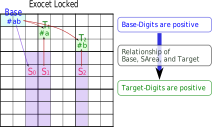
JExocet Locked is true when the "Shape definition" and "Candidate digits conditions" shown below are met.
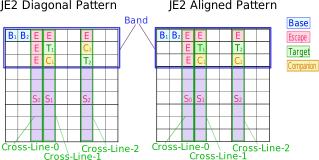
(1) (JE2) Shape definition
Junior Exocet has multiple role cells, arranged as shown in the following diagram.
- Base cells are placed on mini line within a block.
- Escape cells are positioned complementary to Base cells.
- Target cells can be placed in two ways: diagonal or aligned.
- Companion cells are placed in conjunction with the Target cell's position.
* [Additional information for understanding of Exocet]
To understand how Exocet works, it is helpful to distinguish between "directions."
Using the "Base alignment" as the reference, a direction parallel to this is "Parallel".
A direction that intersects with this is "Cross."
When it is clear from the context, these are often omitted.
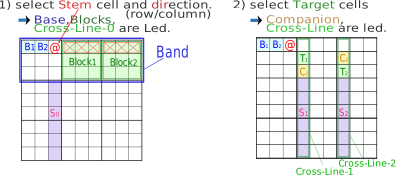
The shape of JExocet is derived through the following steps, which can also be used as a reference when creating JExocet solution code.
-
Step 1: Select one cell (Stem cell) on the board and its direction (row/column). This determines the mini-line.
The mini-line's two Base cells (B1, B2), Band, and two Blocks (Block 1, Block 2) are determined. Additionally, Cross-Line-0 is determined based on the Stem cell and direction.*Mini-line is three cells in a row or column within a block.
*Stem cells are used to guide the shape and are not involved in Exocet logic. Also, stem cells can be either fixed or unfixed.
- Step 2: Blocks1 and 2 each contain six cells that are not connected to the Base.
From each block, select an undetermined Target cell (T1, T2).
The direction and Target cell (T1, T2) determine the Companion cells (C1, C2), Cross-Lines (CL1, CL2), and SLines (S1, S2). These cells can be either determined or undetermined.
Companions play an important role in establishing an Exocet. This will be explained later.
SLines (S0, S1, S2) are the areas outside the Cross-Line band.
Mirror is not related to the establishment of Exocet Locked. GNPX does not deal with Mirror.
(2) (JE2) Candidate digits conditions
Under the definition of JExocet, the following conditions (R1 to R4) are tested.
When all Base Digits satisfy conditions R1 to R4, it becomes Exocet Locked.
JE2 Candidate digits conditions
| R1 | The Base cells(B1, B2) are both undetermined cells and have a total of 3 to 4 base digits. |
| R2 | The target cells(T1,T2) are both undetermined cells and have a total of three or more base digits. |
| R3 | The Companion cell does not contain a Base digits. |
| R4 | For all Base digits, the Base digits in the S region {S0,S1,S2} are covered by two Lines(Houses). |
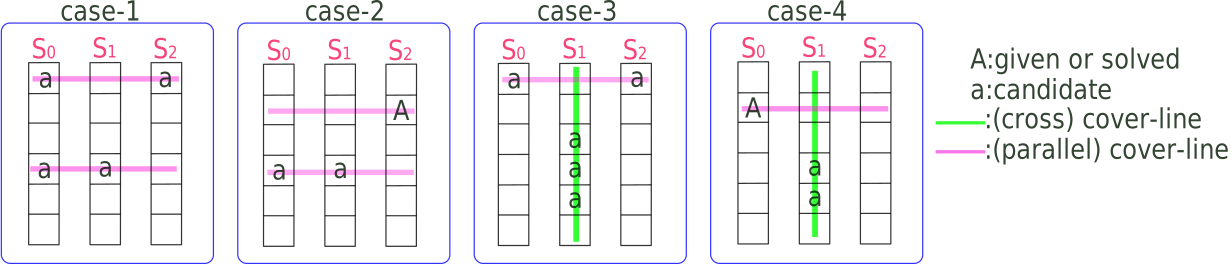
Explain these conditions in more detail here.
| R1’ | If there are two base candidate numbers in the base cell, it is a LockedSet.
If there are 5 or more, it is predicted that "there are more constraints and it is unlikely to exist."
Therefore, R1 is "Base digits between 3 and 4." It will likely expand(3 to 6 in GNPX ver. 6). Two Base cells may not have any digits in common. |
| R2’ | Target can also include candidate digits other than the Base digits. However, if Locked holds, candidate digits other than the Base are negative. |
| R3’ | Companion is fixed or unfixed cells. |
| R4’ | The Base digtis in the S region {S0, S1, S2} can be either candidate digits or fixed digits. |
(3) JExocet logic ... Locked proof
Base digits that satisfy R1 to R4 are Locked.
When select any two digits from the Base digits, the following proposition holds true for those two digits:
Proposition: If the digits in Base are positive, the digits in Target-1 and Target-2 will also be positive.
- Proof of JE2 Locked (CL:Cross-Line)
- L1. In the Base, the Base digits#ab is positive. And in Escape, #ab is negative.
- L2. CL-0, CL-1, and CL-2 each have three instances of #ab (according to Sudoku rules), for a total of six instances.
- L3. Since R4, S-Area(S0,S1,S2) have two #a CoverLines and two #b CoverLines.
- L4. Since "6-4=2", there are instances of #a and #b in the Band area of CL-1 and CL-2.
- L5. The #a and #b instances are not in Escape or Companion, but in Target1 and Target2, respectively.(it is not clear which).
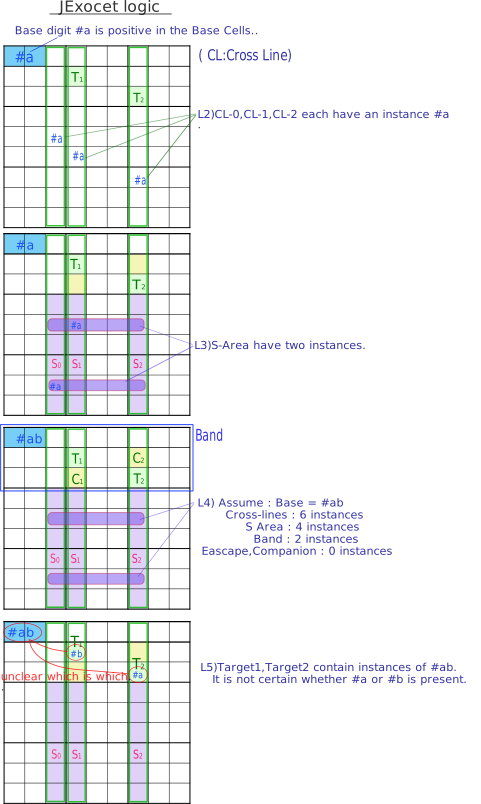
(4) Understanding Exocet Locked
Consider the Exocet Locked
For Exocet Locked, no matter which two candidate digits are selected from the candidate digits in Base,
they will be positive in Target.
The target puzzle has a solution and is a unique solution.
If look back from the solution, any two base candidate digits(#a,#b) are fixed digits(#A,#B).
Since there are three or more candidate digits for Base, if focus on the remaining "#x",
candidate digit #X is negative in Target and positive in Escape.
However, while solving the puzzle, it is not known which of the Base candidate digits is the solution.
Exocet Locked is an inference that is not certain but can still be derived.
A similar inference can be imagined, for example, as LockedSet.
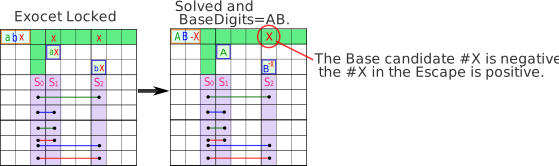
Exclusion
When Exocet Locked is established, the candidate digits may be confirmed as negative.
On this website and GNPX, the exclusion rules are used as follows:
- Exclusion rules are derived from the Exocet definition.
This website uses the JE2 rule numbers from the Bird document.
JExocet Compendium by:David P Bird
http://forum.enjoysudoku.com/jexocet-compendium-t32370.html
- It does not deal with logic that leads to negation/affirmation secondary to the logic,
as with other analysis algorithms.
Secondary effects are analyzed in the next step.
Exclusion rule
-
E3. Non-base digits in Target are negated.
If Exocet Locked, any base candidate digits will be entered in Target. Therefore, there is no room for non-base digits to be entered in Target.
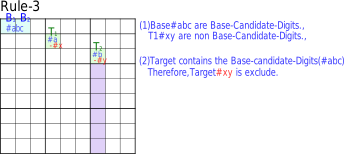
-
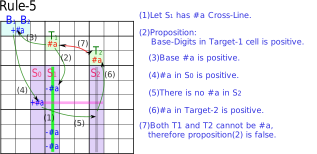
E5. A Base digits with a Cross Cover-Line is negated in the corresponding Target.
This can be derived as follows:- (1) Suppose S1 has a Cross-Cover-Line of #a.
- (2) Proposition: In T1, the Base candidate digitd #a is positive.
- (3) Base #a is positive.
- (4) S0 has #a instance.
- (5) There is no #a instance in S2.
- (6) T2 has +#a.
- (7) T1#a and T2#a are in conflict (other Base digits cannot be placed in Target).
Therefore, (2) proposition is false and #a of T1 is negative.
Exclusion - 2
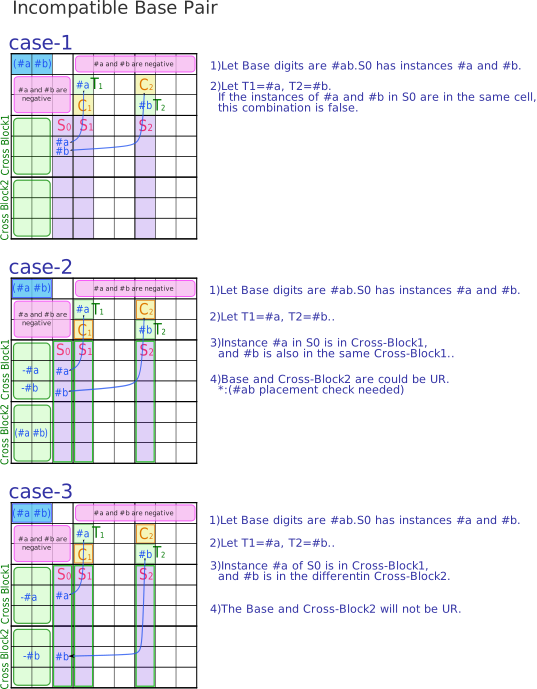
Exclusion-2 is an exclusion with two Base digits. In the Bird documentation, it is listed under "Incomtible Base Pairs".
The candidate digits in the two Base can be freely combined and are not candidate Base digits.
For example, if the candidate Base digits are (1,2,3), the possible combinations are {(1,2),(1,3),(2,3),(2,1),(3,1)(3,2)}.
Also, if the candidates in the two Base digits are different, this will be a possible combination pattern.
Test each of these combinations. Based on the characteristics of Exocet, use the following:
- The Base digits to be tested are in Target.
- The instances of the two Base digits are in S0. The instances may be fixed.
- The two Cross-Blocks of the two Base Cells have the Base digits of the candidate.
There are three types of instances in S0.
- Case-1:Two instances of Base digits in S0 are in the same cell.
This pattern is not a possible Sudoku solution, so this combination pattern can be ruled out. - Case-2:Two instances of Base digits in S0 are in the same Cross-Block.
This pattern eliminates all Base digits in the cross-block.
It has no effect on the other Cross-Block.
Therefore, this combination has a Base and UR relationship,
The uniqueness of the Sudoku solution means that this combination pattern can be ruled out. - Case-3:The instances in S0 of the two Base digits are in different Cross-Blocks.
This pattern eliminates each Base digit in each Cross-Block.
In this case, it will not be Base and UR.
Therefore, this combination pattern remains a possible solution.
"Exclude-2" detects ineligible Base digit combinations.
GNPX tests "Exclude-2" before "Exclude-1".
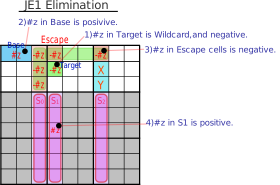
Junior Exocet_1 (JE1)
JE1 is a type with one Target.
In JE2, a fixed digits (the Puzzle digits or a fixed digit by analysis) is located at the location of one Target.
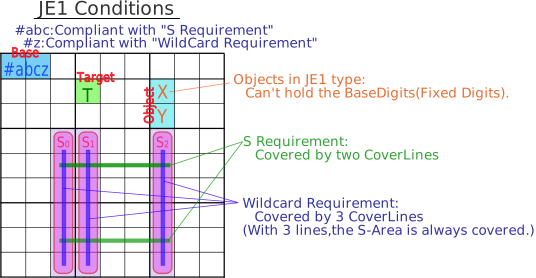
The elements of JE1 are a Base, a Base digit, one Target, and a fixed digit Target(an Object with a fixed digit other than the Base digit).
The crossline of the Base, the Sline of the Target, and the blank Object are defined in the natural form of Junior Exocet.
There are two types of cover for S cells {S0, S1, S2}. This is a condition unique to JE1.
- S Criteria: Covered by two CoverLines.
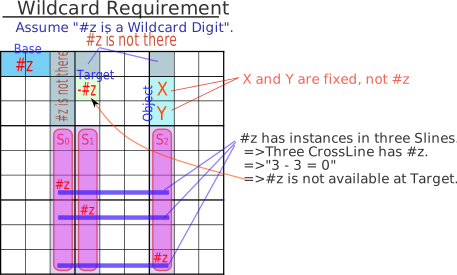
- Wildcard Criteria: Covered by 3 CoverLines.
JE1 logic
The following logic applies depending on how the Base digits of JE1 are covered.
-
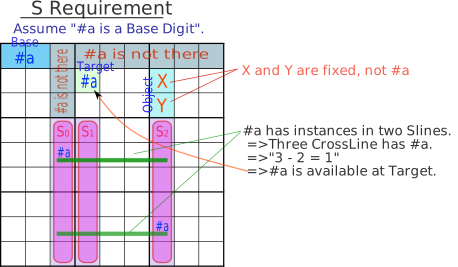
(1) Base digits that meets S criteria
- Proof of "S Criteria Locked" (CL:Cross-Line)
- 1)Assume that Base digit #a has two CoverLines in the S area.
- 2)A CrossLine containing the S-area requires a total of three #a instances.
- 3)Therefore, there is #a in Target.(3-2=1)
-
(2) Base digit that meets the Wildcard criteria
- Wildcard Criteria Certification (CL:Cross-Line)
- 1) Assume that Base digit #z has more than 2 CoverLines in the S region.
- 2) A CrossLine containing an S-Area requires a total of three #z instances.
- 3) Therefore, there is no #z in Target. (3-3=0)
JE1 Exclusion
If JE1 holds, the next exclusion can be made.
- The Target Wildcard (#z) is determined to be negative.
- The Base Wildcard is determined to be positive, and the other Base digit is undetermined.
- The Escape Wildcard is determined to be negative.
- The Sline-1 Wildcard is determined to be positive. If there is only one, all other candidates other than the corresponding cell's Wildcard can be eliminated.
- By determining the Base and Target Wildcards, the Wildcard digit in its sphere of influence becomes negative.
Exclusions 4 and 5 are cascading exclusions, so they are not supported by GNPX.